After the death of Angie Xtravaganza in 1993, Jesse Green wrote this piece for the New York Times about the impact of “Paris Is Burning" on the people whose lives it chronicled. Thanks to Matthew Hill for the link.
House of Xtravaganza
LOOKING like endangered birds, the drag queens tottered on their
heels as they entered — “a bit early in the day for we girls," said one.
It was noon on a recent Saturday at the Sound Factory Bar on West 21st
Street, and they were attending a memorial for Angie Xtravaganza. One of
her children, Hector Xtravaganza, kept breaking down in tears. “It’s
not just her, it’s all of them," he said. “My entire gay childhood is
disintegrating before my eyes." Indeed, as some of the 100 mourners rose
to reminisce, it was as if their whole world, the world of drag queens
and voguing and ecstatic, elaborate balls, had died along with Angie.
Though she was only 27, Angie had been a mother more than a dozen
times. Not in the usual way; she was biologically male. “But a mother is
one who raises a child, not one who borns it," Hector pointed out. And
as mother of the House of Xtravaganza, Angie had taken many rejected,
wayward, even homeless children under her wing; she had fed them,
observed their birthdays, taught them all about “walking the balls."
Competing in categories like High-Fashion Eveningwear and Alexis vs.
Krystle, Angie was legendary, a Queen among queens, achieving in fantasy
what the world had denied her in reality.
Drag balls, the product of a poor, gay and mostly nonwhite
culture, had been held in Harlem since the 1920’s. But it wasn’t until
Jennie Livingston’s award-winning documentary, “Paris Is Burning," was
released in 1991 that anyone outside that world knew much about them. By
then it was almost too late. For Angie Xtravaganza, such fame as she
achieved in the two years following the film’s release could not be
savored: the AIDS-related liver disease that eventually killed her was
already destroying her hard-won femininity. “She had spots all over,
like a Dalmatian," Hector said. “And she had to stop taking the hormones
that made her look soft, because they’re what really ate her up." In
later pictures, you can see the masculine lines of her face re-emerging
despite the high collars and makeup.
But it wasn’t just Angie. Before filming was even completed in 1989,
her “main daughter," Venus, a frail transsexual who in the movie dreamed
of marriage and a home “in the Peekskills," was found strangled under a
bed in a hotel. Since then, Kim Pendavis, filmed sewing his costumes,
has died of a heart attack though he was only in his 20’s. Of nine
featured players, five are gone or going.
Paris is no longer burning. It has burned. And not only because of
the casualties. No one needs to go to a ball to see drag anymore: Dame
Edna Everage has television specials, Ru Paul mugs on the covers of
magazines, fashion shows feature drag acts on the runway. No one needs
to go to a ball to see voguing either, not since Madonna gobbled it up,
appropriating two Xtravaganzas in the process. Once mainstream America
began to copy a subculture that was copying it, the subculture itself
was no longer of interest to a wider audience, and whatever new
opportunites existed for the principals dried up. After one show last
year at the jazz club Sweetwaters, Octavia St. Laurent, for instance,
returned to dancing behind glass at the Show Palace. And the balls,
which had moved downtown in their moment of fame, have mostly moved back
to Harlem.
The film’s critical and financial success should therefore not be
taken for the success of its subjects. “The truth is, though I didn’t
get rich, I am now a film maker," said Ms. Livingston, 31. “And that’s
something I wasn’t before. It doesn’t mean it’s easy to get money. But I
am educated and I am white so I have the ability to write those grants
and push my little body through whatever door I need to get it through."
And drag queens can’t. “If they wanted to make a film about
themselves, they would not be able," said Ms. Livingston, who grew up in
Los Angeles and is a graduate of Yale University. “I wish that weren’t
so, but that’s the way society is structured." In fact, other than Willi
Ninja, the movie’s star dancer, who has stitched together a career
including choreography, fashion and music, the characters Ms. Livingston
presented remain, at best, where they were when filmed.
Angie Xtravaganza’s memorial made that all too plain. A shrine had
been set up in the back of the room: flowers, photographs and, on a
pedestal, a pair of Angie’s favorite earrings. Behind them stood a huge
funeral wreath, a giant X of blood-red carnations that seemed to stand
for more than Xtravanganza. Almost unnoticed was a simple basket of
white and purple lilies. “To all who loved Angie," the florist’s card
read. It was from Ms. Livingston and her co-producer, Barry Swimar, who
were in England to raise money for new projects, including a satirical
drama about the way movies depict violence against women.
Perhaps it was just as well they couldn’t attend. There is a lot of
anger in the ball world about “Paris Is Burning." Some of it concerns
what a few critics have called exploitation: making the lives of poor
black and Latino people into a commodity for white consumption. “The
complaint is somewhat unfounded," Ms. Livingston said, “as it was
largely a gay audience, which included blacks and Latinos, that made the
movie successful."
"Anyway," Ms. Livingston continued, “I don’t believe you have to be
one thing to make a film about it. I’m white, yes, but I’m an openly
queer, female director, and I can’t think of anything more out of the
mainstream. I’m sorry, but I do not think I have the same relationship
to the ruling class as a straight man."
But most of the anger centers on money. “I love the movie, I watch it
more than often, and I don’t agree that it exploits us," said Pepper
LaBeija, 44, whose braggadocio and fierce but fey style made him a
standout in “Paris Is Burning." “But I feel betrayed. When Jennie first
came, we were at a ball, in our fantasy, and she threw papers at us. We
didn’t read them, because we wanted the attention. We loved being
filmed. Later, when she did the interviews, she gave us a couple hundred
dollars. But she told us that when the film came out we would be all
right. There would be more coming.
"And that made me think I would have enough money for a car and a
nice apartment and for my kids’ education. Because a number of years
ago, to please my mother, I took a little break from being a 24-hour
drag queen, and so I have a daughter, 15, and a son ready for college.
But then the film came out and — nothing. They all got rich, and we got
nothing."
Miramax, which released the film, said that “Paris Is Burning"
grossed slightly more than $4 million at theaters in the United States.
This is not much compared to a Hollywood hit but is exceptional for a
documentary that cost only $500,000, including $175,000 for music
clearances, to make.
Ms. Livingston would not say how much money she made from the movie.
“There was a rumor in the ball world — and this delights me — that I now
have a house on Long Island next to Calvin and Kelly Klein," she said.
“But the truth is I live about the same as I did, except that I used to
be chronically about three months late in paying the rent, and now I’m
more or less on time."
STILL, all but two of the movie’s surviving principals — Willi Ninja
and Dorian Corey — hired lawyers to try to cash in on the film’s
success. The largest claim came from Paris DuPree, who sought $40
million for unauthorized and fraudulent use of her services. Though she
is never named on camera and appears for less than three of the movie’s
76 minutes, her 1986 ball, called Paris Is Burning, provided the title
for the film and is extensively featured in it. But like all of the
others, she had signed a release, and her lawyer dropped the matter.
"There’s no obligation, in a documentary, to pay your subjects," Ms.
Livingston said. “The journalistic ethic says you should not pay them.
On the other hand, these people are giving us their lives! How do you
put a price on that?"
Somehow, she did. Ms. Livingston said that even before the threats of
lawsuits, she had decided to pay about $55,000 to 13 performers, based
on how long each appeared on screen. And in 1991, after the claims
against her had been dropped, the money was distributed.
"I think Jennie has complied with the spirit and with the literal
representations she made along the way," said Peggy Brady, a lawyer who
represented Ms. Livingston’s production company. “Besides, in our
society, we try to encourage the free exchange of information."
Pepper LaBeija was not appeased: “The $5,000 I got was hush money. We
didn’t have no choice but to take it. And $1,500 went to my lawyer for
doing nothing." He paused, and the musical, swaggering tone familiar
from the film returned to his voice. “But at least it brought me
international fame. I do love that. Walking down the street, people stop
me all the time. Which was one of my dreams doing the drags in the
first place.
"What hurts is that I’m famous but not rich. A California magazine
said I had sued Miramax and won untold millions and was seen shopping
with Diana Ross on Rodeo Drive in a Rolls. But I really just live in the
Bronx with my mom. And I am so desperate to get out of here! It’s hard
to be the mother of a house while you’re living with your own mother.
Why couldn’t they give us $10,000 apiece?"
Ms. Livingston defended the size of the payments. “If they’d been
actors in a dramatic film the size of ‘Paris Is Burning,’ they would
have made a whole lot less," she said. Of course, if ‘Paris Is Burning’
had been a drama, Ms. Livingston might have earned a whole lot more. As
it is, she said she had seen nothing beyond her guarantee. “If we get
more money, in all likelihood we’ll distribute more money." Mr. Swimar
said. But nothing is likely to smooth Pepper LaBeija’s feathers. If the
best documentarian never fully captures her subjects, it’s also true
that best subjects never fully accept being captured.
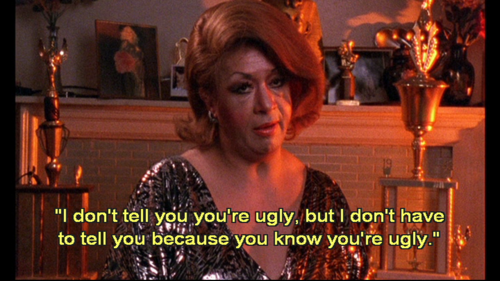
"Oh yes, to this day a lot of the girls hate Miss Jennie, but that’s
just greed," said Dorian Corey, by all accounts the star of the movie.
She is sitting in a makeshift dressing room at Sally’s II, a drag bar
just west of Times Square on 43d Street, applying stage makeup over her
street makeup — there’s not much difference — in preparation for her
Thursday night show. “Junior LaBeija pitched a bitch in The Amsterdam
News, saying he wanted $50,000 because he was the star of the movie. But
the Bette Davis money just wasn’t there. I’ll tell you who is making
out is those clever Miramaxes. But I didn’t do it for money anyway: I
did it for fun. Always have."
She dabbed white greasepaint on her eyelids. “You see I was in show
business for years, so when my 15 minutes finally came, it was gravy.
And what I got from the publicity tour you couldn’t buy. They paid the
hotels and limos. I didn’t even buy cigs; I just signed. I got to be a
star! In Boston, the black children were coming up to me with tears in
their eyes! It did whet my appetite, and I hoped that crazy little
Jennie would have done a sequel, because once you do something big, you
want to do it again. But what I got was plenty, and the rest is just
bitter onions."
The room in which Dorian would emcee her “Drag Doll Review" was dim
and dingy, encrusted with the detritus of many louche incarnations:
amorous murals, go-go lights, mirror balls, boudoir lamps. Drag queens
of every size and style huddled around the bar, trying to stir up
business from average-looking men in dull business attire. From “Paris
Is Burning" it might not be evident that this is part of the drag world,
too; yet more than one of the movie’s leads can often be found here,
looking for customers.
"Welcome to Sally’s II," said Dorian drily. “The original, just down
the block, burned down." She narrowed her eyes. “And when this one
burns, we’ll move on up the way."
At 55 — “Put me down as 27 and say it’s a two-for-one sale, honey," —
Dorian comes from a different age of drag than most of the others in
“Paris Is Burning." “These children, it’s a new world now. Most of them
make their money turning tricks. It’s that or starve! I myself" — she
pulled off her red shift and shimmied into a sequined floor-length
magenta dress with rhinestone spaghetti straps — “am lucky to have
avoided all that. I’m an old farm girl, from Buffalo, and when you’ve
had that healthy beginning, you don’t go the same way."
Dorian slipped into a pair of gold pumps, then poured jewelry from a
bag onto the Formica counter. “And today it’s so risky, with the
almighty shadow opening the door." She arched one enormous eyebrow in
deference to AIDS. “Even I have to the worry. I’ve had such a torrid
past. So now I’m a VCR queen, if you know what I’m saying. You don’t
have to give a VCR breakfast."
She examined some delicate fake pearl earrings, then rejected them in
favor of a pair with four-inch dangling rhinestone strands, which kept
falling off. “I’m not trying to look real," she said, getting out the
glue. And, true enough, with her platinum wig and elaborate eyes, she
looked like a cross between Tina Turner and Barbara Cartland, albeit
with stubble in the cleavage of her silicone-enhanced breasts.
"I love all that madness," Dorian said. “Ru Paul, Lypsinka, Liz
Smith. But I tell the children to think very serious, and if it’s at all
possible avoid the drag life," Dorian said. “It’s a heartache life. If
you do pursue it, make sure you get your education, some kind of skill. I
always supported myself with my sewing. But the oldest profession is
still the easiest, though there’s nothing so pitiful as a 50-year-old
prostitute. It’s a one-way street with a very bad end."
But her advice seemed to go as unheeded as her show at Sally’s.
Opening with “It’s Today" from “Mame," she had to signal the sound man
to turn up the volume in hopes of commandeering attention. Occasionally,
when one the patrons did take notice, he would approach Dorian in
midsong and stuff some dollar bills down the front of her dress. Dorian
didn’t even blink.
She got a better response at Angie’s memorial. It had been a painful
afternoon, but when Dorian walked toward the shrine in her fur hat,
sunglasses, rain jacket and purse, she was greeted with a huge round of
applause. She was, after all, another legendary mother. “It’s O.K.,
children," she drawled, “because Angie’s got something now that we’ve
lost: a little beauty, a little peace. And it’s gonna be hotter and
better up there."
Drag is variously explained as destruction of the male within or the
female without. For Dorian and for many of Angie’s other mourners, drag
is not a means of destruction but of rescue — a little beauty, however
perverse and rococo. This is the achievement that Ms. Livingston
indelibly recorded: the victory of imagination over poverty. But the
victory is Pyrrhic at best. The movie’s title may come from the name of
Paris DuPree’s ball, by which she meant only that the competition would
be hot, but the phrase itself has a darker history. “Paris brennt?" ("Is
Paris burning?") Hitler asked , wondering whether the city had fallen.
And though Paris, France survived, the Paris of Ms. Livingston’s movie —
and all it depicted — may not.
The mirror ball kept spinning at the Sound Factory Bar. It wasn’t
until after 3 o’clock that everyone who wanted to speak had spoken. The
crowd went quiet. A man asked everyone to hold hands in a circle.
“Remember," he said. “We are all legends."