Showing posts with label Terre Thaemlitz. Show all posts

Tuesday, 20 August 2013

DJ SPRINKLES in-depth interview part 2


Here's part two of my hour-long interview with Terre Thaemlitz, aka DJ SPRINKLES, from Glasgow's Tramway Theatre earlier this year, as part of Arika Episode 5: Hidden In Plain Sight. In this section we discuss politics and the difference between activism and organisation, how Terre's rejection of the "soul" goes against notions very commonly associated with "deep house", and how being an aetheist can effect her own position within the transgender community. 


You are primarily known as a "deep house" dj and producer, and yet so many elements of that culture have to do with "spirituality", and not even a religious spirituality. In the UK, I feel, house music culture and the drugs that surrounded it was in a way a kind of secular spiritual rebirth, though it didn't have a language to express that necessarily. I find it very interesting that you are directly oppositional to that. 

I am directly oppositional to that, but I also have no hope of crowds of people overcoming those spiritual subtexts.  But the promise of overcoming is not what is important, resistance is what is important. 

But do you find that your position alienates you from certain parts of the house music genre? Are there songs you wouldn't play? 

Absolutely there are things that I won't play. But there are also things like that I will play, I just happen to like them in some way. And I will deal with them. Like "Inspiration" by Arnold Jarvis, a track that is politically antithetical to my own nihilism. But I love it! And the irony of a track like that in one of my sets is not lost on everyone. You have to allow for humour, and camp. And hypocrisy, and "the fake" and all these things that are also a part of drag culture and transgender culture... I guess for those reading this who don't know anything about me, we should mention I identify as transgender, by the way...

So do you find your nihilism puts you in opposition with members of the transgender community? 

When it comes to spirituality among trans-folk, I do think that, especially with the dominant movements of transgenderism and transsexuality, in terms of their approaches towards transitioning strategies and stuff, that they lend themselves towards metaphysical interpretations because they often rely on a perceived division between physical body and inner self, and position that division as something to be resolved or transcended. In particular, that "mental health" comes through binary gender reconciliation. And of course, if that is the dominant discourse heard from trans-support groups and medical professionals, it then makes sense that this is a belief pattern many people ideologically fall in to, and I am sympathetic to that process. At the same time, that's not everybody's position nor experience, and there are also a lot of people who are very precise about the material implications of what they are doing, and what exactly it is about gender that they are trying to culturally resist, such as from a feminist perspective within patriarchy. These kinds of approaches are usually not about reconciliation within a binary gender system. Even though this latter group may be the minority in terms of vocality, I don't care, they are who resonate with me, and those practices are what I need to focus on. And I try to do that in a way that *does* interfere, that *does* "culture jam" – not just with dominant culture and society in general, but also with dominant subcultures. With queer communities, with trans communities. And one immediately finds sexuality and gender also interact with issues of race, ethnicity, spirituality and religion, faith and also, of course, class. In the end it all boils down to poverty: who can afford transitioning procedures, who has access to health care, and what lifestyle are they putting themselves into to continue a life of debt due to body maintenance? For me these things are all intertwined, so "solidarity" means I have to find ways to deal with people who are ideologically opposed to myself. When one's own views are in the minority, you would be a fool to think that your task is to get other people to agree with you, but rather how can you continue to work productively with people despite disagreements. And certain types of non-cooperation can also be productive.

I like that way of putting it, as personally I think there's too much emphasis in atheism on making people "change their minds" rather than just learning to co-exist with different opinions 

Again, that comes down to conversion, and I believe that the widespread deprogramming and de-indoctrination of spirituality is a social impossibility, even under secular humanism, so "atheist conversion" is off the table. I don't have to worry about it. I can attempt to be as clear and concise as possible, and at the same time I can assume that language will fail, due to unfamiliarity or whatever, but that does not invalidate the necessity of the gesture. To the contrary.

That strikes me as being a minority position among atheists? 

Clearly I'm rejecting liberal humanism. I think it's much better to regard atheism as a position of self-defence amid an onslaught of indoctrinations, rather than to position it as a competing ideology. Religious people position it as a competing ideology because they cannot perceive of knowledge or learning as anything other than attempting to grab onto some "truth" floating in the ether that is put there by a divine power, blah blah blah. Everything becomes religion to them because they place the construction of knowledge itself outside the human experience. They see human experience as "trying to understand why we are here" – trying to understanding the intentions of a spirit-energy-god-moster-creator other – whereas materialists see understandings as socially contextual human constructs. So disbelieving something is not always simply substituting one belief with another. From a materialist perspective, religious or spiritual belief is off topic from the necessary discussions of the social and cultural power dynamics behind existing ideologies – religious or otherwise. Similarly, believers tend to think understanding and belief always go together. They manage to fold their disbeliefs back into their beliefs through "leaps of faith." So any actual claim of disbelief is seen as a sign of non-understanding. That's not the case. Some disbelief is a social action born in response to ideological impositions. It is a refusal to cooperate with the social systems giving rise to particular oppressive ideologies, and comes from a deep understanding of what is disbelieved. It's both sad and ironic that non-believers often have a deeper understanding of a subject than those who believe – not only of the ideologies, but of their consequences. Particularly for those of us who have arrived at non-belief as a result of violence from believers. That kind of disbelief is an action-response. Not simply an ideological response, or theoretical tit-for-tat. And our understandings are not fodder for pride. In relation to gender constructs, I think we find this combination of non-belief and deep understanding within non-essentialist transgenderism as well. And that's precisely why atheist non-belief and transgenderism are inseparable for me.

And yet this position, to me, seems very much at odds with traditional modes found within the "deep house" subculture. How do you square your own disbelief in the soul with a genre that is so tied up in ideas about the soul, about "soulful sounds", expressing your "soul" through the music and the like? 

What music could I make that doesn't demand those criteria of soul and authenticity? There is none. So that again goes back to this thing that I mentioned in the beginning, it would be a false mission if I set out to make a true "soulless" sound. I mean, what could be more soulless than the very commercial pop the majority of people inscribe with so much soul? The very idea of some sort of different, authentic language betrays the reality of how we live, subjugated within domination. Internalizing the sounds and associations of domination until we "feel" them, even "love" and take pride in them. That's why my audio often sounds the same as others, despite different intentions. The word snippets that I put into my tracks are hints of where I am coming from, but I have no hope of people on a dance floor picking this up, especially if they are high or drunk or whatever. On the floor, if there's a build up they start screaming, or if the energy goes down they wait for the next build up. So the dance floor is not the moment of organisation and information dispersal, right? That actually happens elsewhere. And that "elsewhere" is how I actually came into house music. House and deep house clubs – in particular the trans clubs in the late 80s and early 90s – these were the spaces where community based activists, mobilisers and organisers went. They were often the spaces they met before they ever became organizers. At the time I was working with a number of organisations, such as ACT-UP (AIDS Coalition to Unleash Power), Women's Health Action Mobilisation (WHAM!), and some others. And the club spaces I stepped into as a youth were politicized. For example, they were the first places to distribute condoms, or do things that were about harm reduction. So the spaces themselves were not just for relaxation, they were places for people trying to protect themselves. They also became testing grounds and templates for implementing harm reduction and educational policies elsewhere in society. So for me, clubs and house music are inherently politicised within that history. Even though most people don't want to annunciate it so bluntly. I don't know if it's because they think some romance or mystique would be lost, or if it's something people these days are just not familiar with, but for me that history and context is something that's impossible to let go of. 

I completely understand that, and I agree. However, I am part of a queer/trans* collective in Manchester called Tranarchy, and while we do do some political acts, I find the language of politics can be very alienating for people. The way I see it, I would rather DO a political act than talk about how it is political, and if people want to read the political aspect into it afterwards, then that's great. 

I think it comes down to how precise language you need, and in what spaces. If some momentum within a space – let's say a dance floor or a ballroom – facilitates a social moment that leads to something else outside the ballroom, then that becomes something that fits in to what you are talking about. But I feel it is important to distinguish between that sort of positioning of music in relation to politics as something that is a time-based and transitional thing carrying us as groups into other social actions; versus the pop culture way music is portrayed as being political, like the "fundraiser" or those kinds of things that for most people aren't rooted in any kind of political investment at all. The politics of music charity are all about feel-good consumerism without consequence. I think the thing we both seem to be interested in is how to trigger political investments, by which I mean commitments of solidarity. But I think the charity idea, or the idea of the protest song, is something that is basically institutionalised at this point, and detaches the consumer or audience from commitment. It actually becomes a cop-out to avoid political investment. This is a distinction that I think is important to make. Otherwise, people will assume that people coming together to a peace-rock-out festival is inherently political. I think it *is* inherently political, but the politics behind it is related to capitalism, and the petit bourgeois' problems, rather than other types of liberation most people imagine.  

It becomes tokenism. 

Yeah. very much. 

That's one of the fascinating thing about vogue culture to me - it doesn't have to be overtly political, because its very existence is inherently political. It's the self-organisation of a minority within a minority within a minority, and it celebrates aspects of culture rejected by society at large. 

I think it is overtly political. There is this idea that overt politics means telling people things. If you are an activist you have a bullhorn and you are shouting, when in fact the real politics of the ball scene have to do with people organising amongst each other around homelessness, addiction and poverty. Trying to deal with problems of sex work, etc. Offering protection is how many houses began. But we can't get all feel-good, because if we're honest we have to confront the fact that a lot of "protection" is also complicated by issues of "pimping." So these are things that are happening internally, but not on the activist bullhorn. Shame and fronting one's class are definitely at play here, but I think things are not off-horn just to hide them. Within a violently transphobic and homophobic world, it's more from the point of view of "who the fuck are you that you need to know my business?" So I think it is a really important thing to get away from this stereotypical model of politics as being activists with bullhorns. But also not to retreat into feel-good "political art" vagary, where "personal feeling" and "dance performance" or throwing a party are seen as in-and-of-themselves "politically enough." That danger is there, especially within music scenes that push people to just go with their feelings, "Love is the Cure," etc. Going with essentialist feelings is what keeps us in a lot of these social messes, particularly around gender and sexual binaries. All too often the results of our "activism" are "happenings" devoid of organising. I think the Vogueology project, and Ultra-Red too, are trying to help people distinguish between political organisation, and political activism. They way I see it, activism is more about the strategic, situational amplification of an ideological message, whereas organisation is more focussed on social responses to crises. Those social responses, through their practices and protocols, ultimately contribute to the construction of ideologies, which in an activist moment can be strategically deployed as an informational bullet. But organising is putting out fires. Activism is the sounding of an alarm. So it's important to distinguish between activism and organising, if that makes sense.

Monday, 12 August 2013

DJ SPRINKLES in-depth interview, part 1

Is house music really a "feeling"? What exactly are we keeping "real"? How do we define notions of the "authentic" in this cut-and-paste, electronic-information age, and, just as importantly, how do we pick those notions apart again? And anyway, who says an "album" can't be more than a day long?

This was one of the many unexpected directions that my interview with Terre Thaemlitz, aka DJ SPRINKLES, took when we sat down back in May at Glasgow's Tramway theatre. I was in town to review Arika's Episode 5: Hidden in Plain Sight, and to interview some of the weekend-long festival's performers, including Sprinkles. As this was a voguing event, I assumed our conversation would primarily be focused on dance music and gender/presentation. But I was pleasantly blown away by Terre's unique outlook and the explanation of the different philosophies that surround it.

We spoke for almost an hour, and what you read below is only the first 20 minutes of our conversation. So, yes, this interview is definitely what you would call "epic". We did talk about gender, dancing and vogue too, and I will be uploading the rest of this on CVNTY over the next few weeks, presented with as little editing as possible, besides some slight revisions made by Terre.


So how did you come to be involved in Arika and the Hidden In Plain Sight project?

I am here under two different aliases. One is Terre Thaemlitz, which is my legal name. On Saturday I am doing a lecture as Terre, and then in the evening a concert with video performance, all based around a project which is called "Soulessness". And then tonight, as DJ Sprinkles, I am djing at a club called Stereo. I'm doing the warm-up set for Vjuan Allure.

Do you know Vjuan?

No I don't know Vjuan, I have to confess ignorance 'cos I am so out of touch with the new school scene, and also I left New York in '97. For the last 12 years I have been living in Japan, so I am quite removed form a lot of western references in general. I am happy to meet people though, because of this whole Ney York revival of the scene, and Michael and the people doing the Vogueology project. It's exciting for me.

I have to admit, the line-up for HIdden In Plain Sight, and tonight's gig at Stereo, is very impressive. I'm always a bit sceptical when I see artists or groups appropriating vogue culture, but Arika definitely seem to be doing it well.

I think Arika are interested in having it connect to the people who come to their usual shows. One of the connections that has come up, in a few of their episodes, is the history of Glasgow in connection to the slave trade and how that connects to African American culture. So I think that is part, on a material history level, of trying to see these traces. But it's also one of these things where it takes a weird international meeting in Glasgow for us to meet each other.

Can you explain to me what your talk/presentation and show tomorrow are going to be about? 

What I am doing tomorrow is a project called "Soulessness", which I have billed as the world's first full length MP3 album. The format is a 16Gb micro SD card that has over 32 hours of music, 165 pages of pdf text and images, and then 80 minutes of video. The text and video are also translated into 10 different languages. The idea is that the centrepiece is a 29 hour and 40 minute MP3 file that is just under 4 Gb, which is the maximum file limitation size under fat32 requirements, and that is how I came to define how long an MP3 album would be. So the theme of that particular piece, which is called "Meditation On Wage Labour and the Death of the Album", is about how, with the transition from album to CD, and then from CD to MP3 (where we have the CD plus digital exclusive downloads, etc) and then the press demanding online mixes and stuff, basically as producers we have been conditioned to produce more and more content over the years. At the same time the labels are playing lower royalties and advances, etc. and this, for me, represents a labour crisis.

So I wanted to do a piece about this crisis of the ever expanding definition of what the album is, based on media format duration. Because these days we tend to think of the album as a conceptual framework, but actually concept of "the album" was first defined by vinyl playback duration, where you can have up to 18 minutes of audio per side before introducing notable sound degradation. Before the CD, vinyl albums were 36 minutes to 40 minutes. The CD album went up to 74 (then 78 and 80) minutes. So that 30 hour, 4GB MP3 file is Soulnessless' audio centrepiece, and it's accompanied by a text on the themes of meditation, wage labour and the death of the album. It's thinking about how materialist practices and analyses are burdened by always using language that is in servitude to, and created by, dominant cultures - which are almost always in service to the right. So the language we are left with to construct our critical analyses is contaminated in this way. The piano recording itself was done in sessions of about 8 hours each, and one of the underlying questions to the sessions was, "can this meditation be on material practice rather than on something spiritual?"

So that is Canto V, but my performance tomorrow night is actually focussing on Cantos I-IV. They also try to investigate and deconstruct spirituality. Or to put it more precisely, it's a rejection of spirituality within audio production, and how that also collides with issues of gender within audio production. So some pieces pursue transgendered issues, as well as electronic music production's relation to gender (because it is typically so male dominated). For example, there is one Canto called "Pink Sisters" in which I attempt to identify unmapped or unconsidered locations where these issues of gender, spirituality and electronic music collide - and that quest led me to interview nuns about  their use of electronic audio equipment: microphones, amplifiers, electronic keyboards, etc. But of course, even in their extremely "alternative" and off-radar activities, the nuns are not necessarily "inspiring" or "different." Their aesthetics are clearly inflected with standard music rhetoric of "soul" and spirituality, and that rhetoric actually defines their conservatism. My intention was not only to document the nuns, but to draw parallels between their activities and the activities of most "alternative" and off-radar experimental electronic music producers. For me, the disappointments and problems raised by "experimental" and academic computer music producers are often quite similar to those of the nuns.


What do you mean by a "rejection of spirituality"?

Well, I am coming from a very atheistic and also anti-spiritual and anti-religious position. At the same time, the way I look at atheism is not in this kind of trendy way where it's about, you know, educating people to figure out it's bullshit or whatever. It's more out of a position of hopelessness, where I really do believe atheism can never be a populist movement because people are too stupid.

I believe that, even if we get rid of religious organisations, we are still trapped by spiritual dogma and superstition. And even within the whole rhetoric of western humanism where, even if you step out of the religious realm, you still have a monotheistic notion of the shared human experience that underlies humanity itself.

So, from my stance, atheism is simply a means of resisting and deprogramming amidst a hopeless situation. House music is always classified as being "spiritual", and as a house producer, I'm someone who buys and listens to a lot of music that is produced with those intentions and overtones, and of course the different club scenes themselves use this rhetoric of soul and spirit. But, as atheists, similarly as queers or trans people, we build unintended relationships to dominant media. Vogue is an ideal metaphor for what I am talking about - it's not even a metaphor, it's action! So for me, rather than trying to invent a new language to discuss this, it's more about how has the history of resistance against religion, of resistance against spirituality, etc, how has it manifested itself within the limitations and context of dominant linguistic and audio formats? That goes back to the 29 hour piano piece that takes the idea of meditation as deep thought on something that could be about material process or labour. Getting away from the idea of the authentic, from the idea of doing something new. Getting away form the idea of inventing a new sound or a language that would be ideal, or whatever. Of course, my rejection of authenticity and naming puts me at odds with certain aspects of the vogue scene which is about acknowledgement and branding, but that's also part of the hypocrisy of life.


There must be conflict between your outlook and most house producers?


Sure, and not only house producers; for example, tonight I am djing house music, but tomorrow night is not house music. The Soullessness thing is not house, it's more in the realm of ambient, computer music, so the conflict is with other types of producers as well. So of course there is a lot of resistance, even to the idea that producers should be able to verbalise and think and express what their intentions are. Because how many people, just like in the visual arts, back away and say "I just want the song to speak for itself" or…

"house music is a feeling"

...yeah, and I guess for me "feeling" is also something that is suspect, because we are conditioned to feel our genders are natural, for example, or our sexualities are natural. I think most people these days would identify with that. If you asked if they feel they were born male or female, most people would say one or the other, yes. If you asked people if they felt they were born heterosexual, or born homosexual, most people within those two options, would say yes. So feeling, that house "feeling" is also something that is suspect, when positioned in relation to queer cultures or trans cultures. and that is something I am interested in speaking about generally and creating discourse about.

But again, it's not about the idea that this is a completely new and unheard of discussion in need of a new language, or that what I'm talking about is some sort of surprise. It is more like, "how have these discussions existed historically, and in what ways and forms, through appropriations of dominant cultural languages and other familiar representational processes?" Which is not so dissimilar to how voguing appropriates imagery from dominant western cultures.


How did you come to reject spirituality, personally? Is it a deliberate rejection, a decision you have made?


For me it is a decision, and I think it is better when it can be a decision, as opposed to something that is done with ambivalence, trying to ignore the problem in the hope that it will go away. Being decisive and thinking about organisational strategy is something I am interested in. And I also think it's something a lot of the people with Vogueology, Michael Roberson, Father of the House of Garcon etc, are very interested in the idea of organising. And this is not simply to do with an exercise in analysis, it has to do with communal organising of resistance to dominations. I know it's tragic, but there was a murder of a trans woman in New York last week and Michael is actually in the process of organising the memorial right now, here in Scotland. So there's these really upsetting subtexts to the issue of organising too.

OH YOKO "Seashore (Sprinkles' Ambient Ballroom Mix)"

Monday, 17 June 2013

ARIKA 5: Hidden In Plain Sight reflections

Unpublished review of Fri/Sat afternoon events at ARIKA 5 for The Skinny


There's always going to be a certain amount of tension when street culture rubs up against highbrow academia, and it's a testament to the skill of Arika that they managed to programme their Hidden In Plain Sight mini-festival (mostly concerning vogue and drag culture) with as little as possible.


Me! 

Hidden In Plain Sight kicks off on friday night at the Tramway with a dance performance called "20 Looks or Paris Is Burning at the Judson Church" a contemporary, semi-improvised piece that aims to fuse pre-post-modern, envelope pushing outlook of the early 60s Judson Dance Theatre with the spirit and ethos of Harlem's vogue balls, which were also beginning to develop in the early 60s. At times these two bedfellows can make a strange mix, and not all of the performances work that well in this context. But when they do work, boy are they good. My personal favourite is the drag performer Francois Chaignaud, a gifted singer/dancer/comedienne who manages to raise some belly laughs while looking and performing beautifully. There's a sense of chaos to 20 Looks, multiplied perhaps by a wonky microphone that keeps cutting out, but no matter how wild things get, they never get out-of-control. The sense of co-ordinated anarchy is wonderful, and makes up for the show's tonal disparities (and over 2 hour running time).


Pony Zion

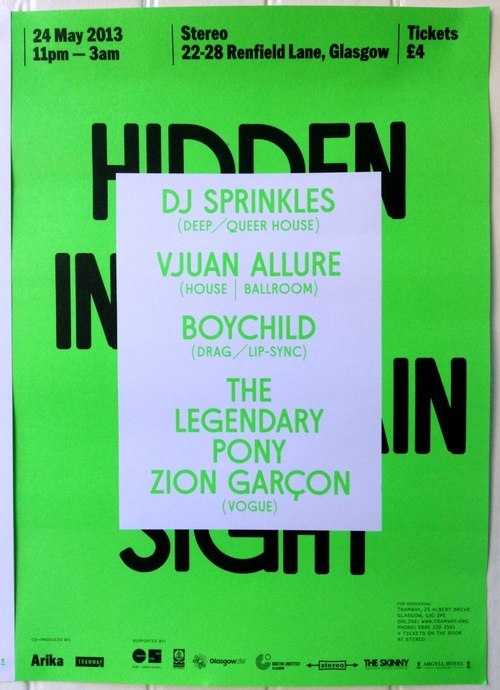
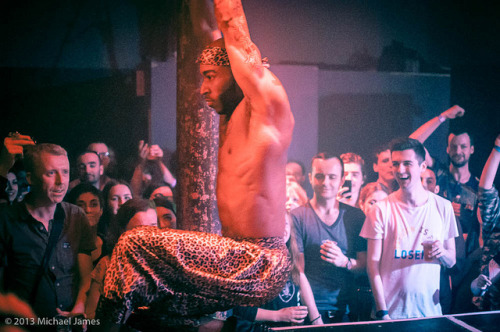
After the Tramway we depart for Stereo on Renfield Lane, to attend the first ever club event that Arika have hosted. This is where it all comes together, where we can experience the music, style and dancing in its most natural home. DJs Vjuan Allure and Sprinkles rev up the crowd with a mixture of throbbing deep house and busy, percussive rhythms, and the music sets the stage brilliantly for two vogue performances by the legendary Pony Zion Garcon (above), and one beautiful and scary lip-sync by the brilliant boychild. Pony Zion is a founding member of the dance troupe Vogue Evolution, and a true "legend" on the dance scene, so to see him bring those incredible moves to a stage in a Glasgow basement is beautiful. Also 10s across the board for both the DJs, and it's personally very satisfying to see the Glasgow audience, who are well versed in house music history, soaking up Vjuan Allure's fresh "ballroom" style, a new take on house that has yet to infiltrate the mainstream but which makes the Glasgow crowd go wild.


 DJ Sprinkles

Saturday afternoon and I am back at the Tramway to attend to talks before I need to catch a train back to Manchester. The heat on this surprisingly glorious day is stifling. The first talk is a round table discussion featuring members of the collectives Ultra-Red and Vogue'ology, and the host Michael Robertson takes us through the history of this very unique culture. At times moving and funny, the talk is great, though I wish more time was given to the actual voguers than the white, middle-class academics, some of whose opinions seem frankly extraneous. Oh, that cultural tension again! The second talk is by Terre Theamlitz, aka DJ Sprinkles, and concerns identity. Theamlitz holding the stage on hir own makes for a more coherent talk than the first Vogue'ology, and I am gutted that I have to go before seeing Terre's actual performance that evening. 

All pics (except for the poster) by Michael James aka Alephnaught, an exceptional club photographer - follow him

Here's a video I shot of some of Pony's performance at Stereo, re-dubbed to Vjuan's "Kid Conga Rebounced": 

<iframe width="560" height="315" src="//www.youtube.com/embed/UKUJ7A8Ufjo" frameborder="0" allowfullscreen></iframe>