Showing posts with label Darren Suarez. Show all posts

Friday, 31 January 2014

'The Untold History of UK Vogue' for FACT Mag part two

Et voila, part two of this epic piece, this time covering my own involvement in the scene, Tranarchy's Vogue Brawl, House Of Trax, Ldn voguer David Magnifique and the daddies of them all House Of Suarez and Darren Pritchard. Read it all here

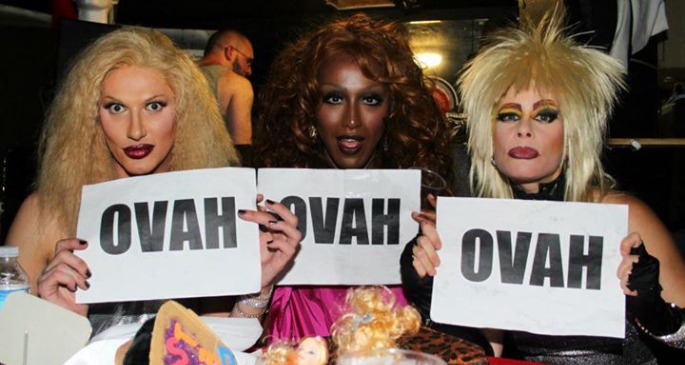
 Judges at Vogue Brawl 2012: Pride Is Burning
As we saw in part one, voguing in the UK comes from a different tradition to that in the States, and even mainland Europe. 

Not based so much on the streets or in the clubs, voguing came to prominence here in the early 90s through professional dance troupes and art and fashion shows. Yet, as with America, the natural home for voguing in this country is still the house ball, where all elements and categories get to work the runway and compete for legendary status. And, although we may be some way behind our European counterparts when it comes to regular balls, the UK is not completely devoid of house balls – though as usual with this scene, you have to look a bit further afield to find the real action.

The UK’s North West is the centre of the current UK vogue renaissance, with annual balls in Manchester, Liverpool, and Glasgow. Time for some disclosure: as The Niallist, I’m a founder member of the Manchester-based queer collective Tranarchy, and since January 2011 we have held an annual ball called Vogue Brawl. In my time, I’ve also helped organise and host the Fierce Ruling Divas Ball in Glasgow, and I’ve DJed at Liverpool’s House Of Suarez Ball under my vogue production alias CVNT TR4XXX. I’m heavily involved in this scene, and right now it’s focussed in spots that are well respected for their dance music cultures and histories, but that don’t necessarily get a huge amount of time in the media spotlight.

We’ve already encountered a young Darren Suarez in part one of this article, voguing as a teenager in the clubs, after hours parties and cemeteries of late 80s and early 90s Liverpool. Flash forward 20 years, and Darren is a professional dance teacher with an idea for throwing a ‘House Of Suarez Ball’. The first of these balls was thrown in 2010, and since then the House Of Suarez Ball has grown to become the UK’s biggest annual vogue function.

NC: How would you describe the HOS ball to someone who has never been?

Darren Suarez: “If you’ve never been to one of our balls, I can guarantee that you will be overwhelmed with colour, dance, energy and fierceness. At least one of the five categories will inspire people. The categories at our ball are Fantasy, which gives creatives in costume and fabric the chance to create big costumes and installations in the theme of the ball, to live out their fantasy, in a way. There is Solo, which is inspired by a solo performer’s confidence to vogue, or perform solo any of the other styles that might fall under that umbrella, such as waacking, hands, femme, new way, old way, etc.
READING IS FUNDAMENTAL! 

Friday, 24 January 2014

'The Untold History of UK Vogue' for FACT Mag part 1

The first partt of my in-depth look at the history of voguin in the UK for FACT magazine, featuring interviews with Les Child and Black Roy form the House of Child, the UK's first vogue house, plus a young Darren Pritchard voguing in late 80s/early 90s Liverpool. Go to FACT to read the whole thing, and also to see the bad ass video footage I've dug out... 


There are many great things about living in the UK.

Of course, it’s not perfect here, but two of the main reasons I like living in this country are the acceptance of gay culture by the mainstream, and the importance accorded to dance music – all music really, from classical to pop. Which is why it’s always been a mystery to me that there is not more voguing going on here.

Vogue culture, or “ballroom” as it is also known, is a highly-developed, immersive culture that originates in the working class, black/Latin@, LGBTQ/drag subcultures of New York City, and more recently other major cities in the United States. Like hip-hop, it encompasses many different forms of self-expression, from music and dancing to art and fashion, while highlighting alternative modes of gender, race and class expression. Without being overtly “political”, vogue culture deals directly with highly politicised issues.

The UK was one of the first early adopters of Chicago house music, not to mention other black-originating music genres from the States like jazz, soul and hip-hop. It’s also traditionally pretty accepting of queer culture, from homegrown heroes like David Bowie and Elton John all the way to the commercial success of acts like the Scissor Sisters. So you would think that the UK would be the perfect breeding ground for vogue. In my experience though, that has not been the case. That’s not to say that there is no voguing happening in the UK, but that, for once, we are far behind some of our European neighbours when it comes to the acceptance and adoption of an American dance music subculture.

...

Britain is not completely bereft of vogue. There have been (and still are) some highly respected voguers in this country. The House of Child was Britain’s first ever vogue house, which was formed in the late ’80s by the professional dancer and choreographer Les Child, inspired by the voguing he was seeing over in the States:
Les Child: “I would go to New York about three or four times a year back in the day, because that was the place to party. It was a bigger world then, you didn’t have the internet and it was like taking a rocket ship and going somewhere else. At the time I was a dancer, I would do some bits of choreography for friends, for films and for pop videos. I was dancing with Michael Clarke at the time, so I would go to New York with him a lot.
“I went to house balls there in the mid 1980s, they were these amazing events. Otherworldly was a good way of describing it! It was like nothing I’d ever seen, it went on for hours, it was a bit intimidating because it was a different culture, a different attitude, a different language, the whole thing. But it was just so brilliant and so captivating. And of course it came from the black experience.”
 IMA READ THAT BITCH